
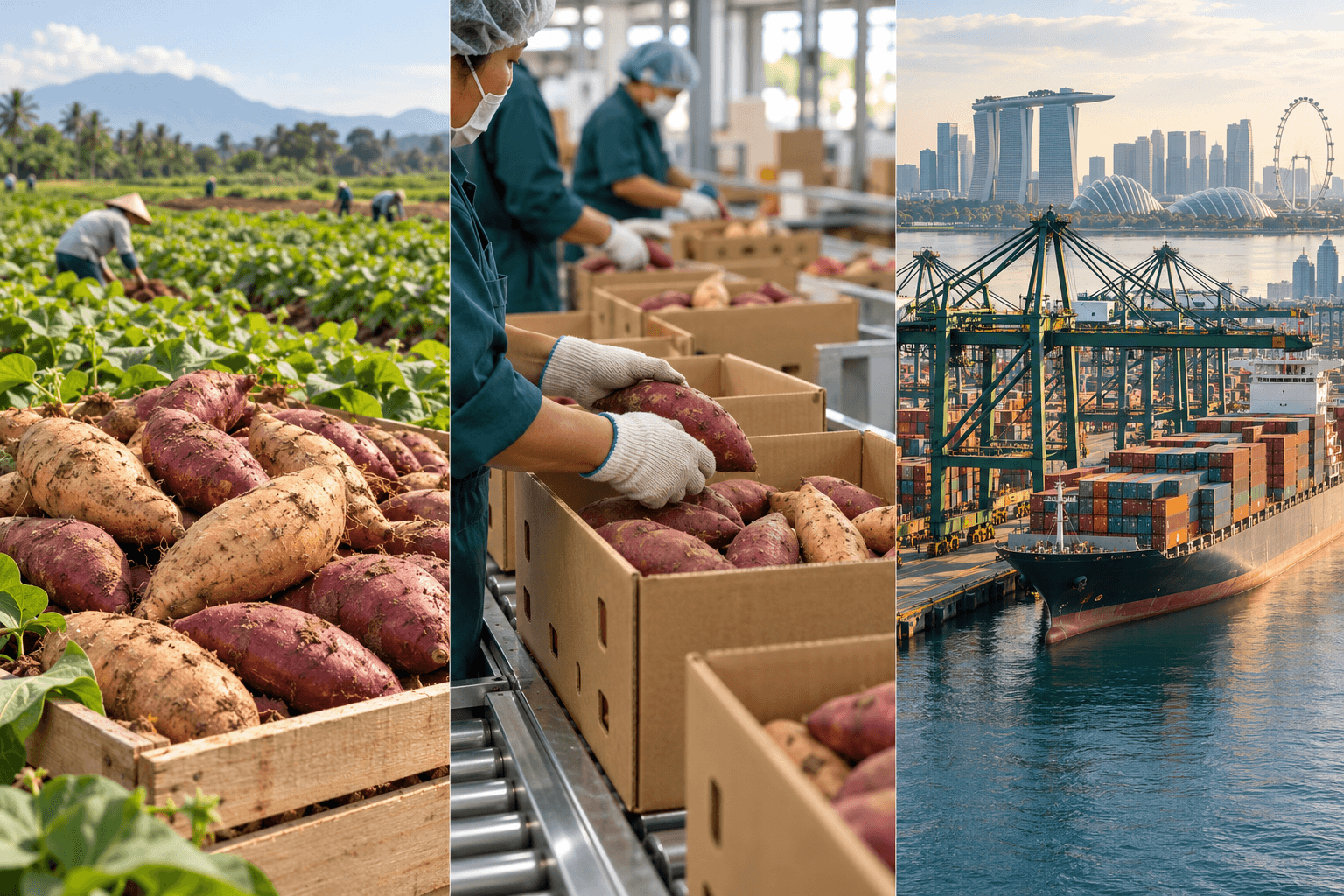
Explore Singapore’s sweet potato imports, leading suppliers, SFA requirements, pricing factors, and sourcing opportunities for Indonesian exporters.
Explore Singapore's sweet potato import market, supplier competition, import requirements, and practical sourcing opportunities for Indonesian exporters and international buyers.
Singapore offers an established destination for Indonesian sweet potatoes, but a successful supply programme needs more than an attractive quotation. Importers must balance variety, eating quality, arrival condition, compliance, and the quantity their customers can sell while the product remains in good condition. This Sweet Potatoes Import Singapore Market Report examines the available trade evidence and translates it into practical purchasing decisions for wholesalers, distributors, retailers, and foodservice buyers.
Report prepared September 2026. Trade comparisons use verified 2023–2024 data; they are not estimates of 2026 imports. Commercial recommendations below are editorial analysis.
Singapore Sweet Potato Imports: Market Size and Direction
Singapore imported 9,944.28 tonnes worth US$13.79 million in 2024, compared with 9,545.98 tonnes and US$13.34 million in 2023. These figures imply volume growth of 4.2% and value growth of 3.4%. The average recorded value eased from approximately US$1.40/kg to US$1.39/kg. Sources: WITS / UN Comtrade, 2024 and 2023.
Understanding What the Figures Measure
The series covers HS 071420, labelled "sweet potatoes, fresh or dried" in the WITS HS 1988/92 classification. It measures gross imports, not domestic consumption or fresh-only retail sales. Average import values are calculated from recorded value divided by weight; they are not supplier quotations.
For procurement planning, the useful signal is a market with established trade flows and competing supply origins. Buyers should still validate demand through their own customer orders, stock turnover, and trial sales. An increase in national imports cannot establish that every variety, pack size, or price point will sell successfully.
Leading Suppliers and Indonesia's Position
| Origin | 2024 volume (tonnes) | Value (US$m) | Average US$/kg |
|---|---|---|---|
| Malaysia | 2,889.13 | 1.55 | 0.54 |
| Indonesia | 2,501.37 | 2.68 | 1.07 |
| Vietnam | 2,200.67 | 2.94 | 1.33 |
| Japan | 1,519.03 | 5.11 | 3.37 |
| China | 377.10 | 0.52 | 1.37 |
Selected leading origins, ordered by volume. Calculations use unrounded source values. Source: WITS / UN Comtrade.
Indonesia accounted for 25.2% of volume and 19.4% of value in 2024. Its supplied volume declined 8.2% from 2023. This supports a measured strategy: defend consistency and customer fit rather than assume automatic growth.
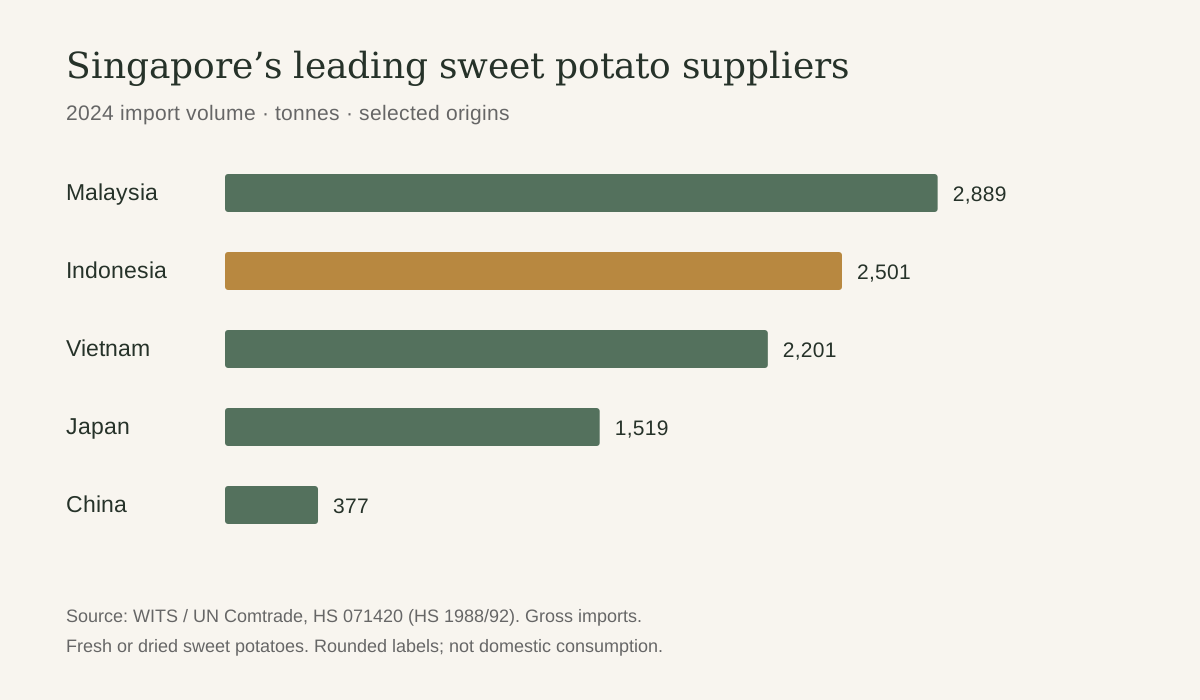 Selected supplier volumes, rounded. Source: WITS / UN Comtrade.
Comparing Suppliers on an Equivalent Basis
Differences between national averages may reflect product mix, grade, presentation, and shipment characteristics. They do not prove a like-for-like quality difference or the margin available to a particular importer. A buyer comparing Indonesian and Japanese sweet potatoes should request samples with the same intended use and assess cooked taste, texture, portion size, and saleable yield.
For Indonesian exporters, a practical positioning strategy is to offer clearly identified varieties, dependable specifications, and transparent shipment records. A price-led quotation becomes more useful when it also explains exactly what the customer will receive and how problems will be resolved.
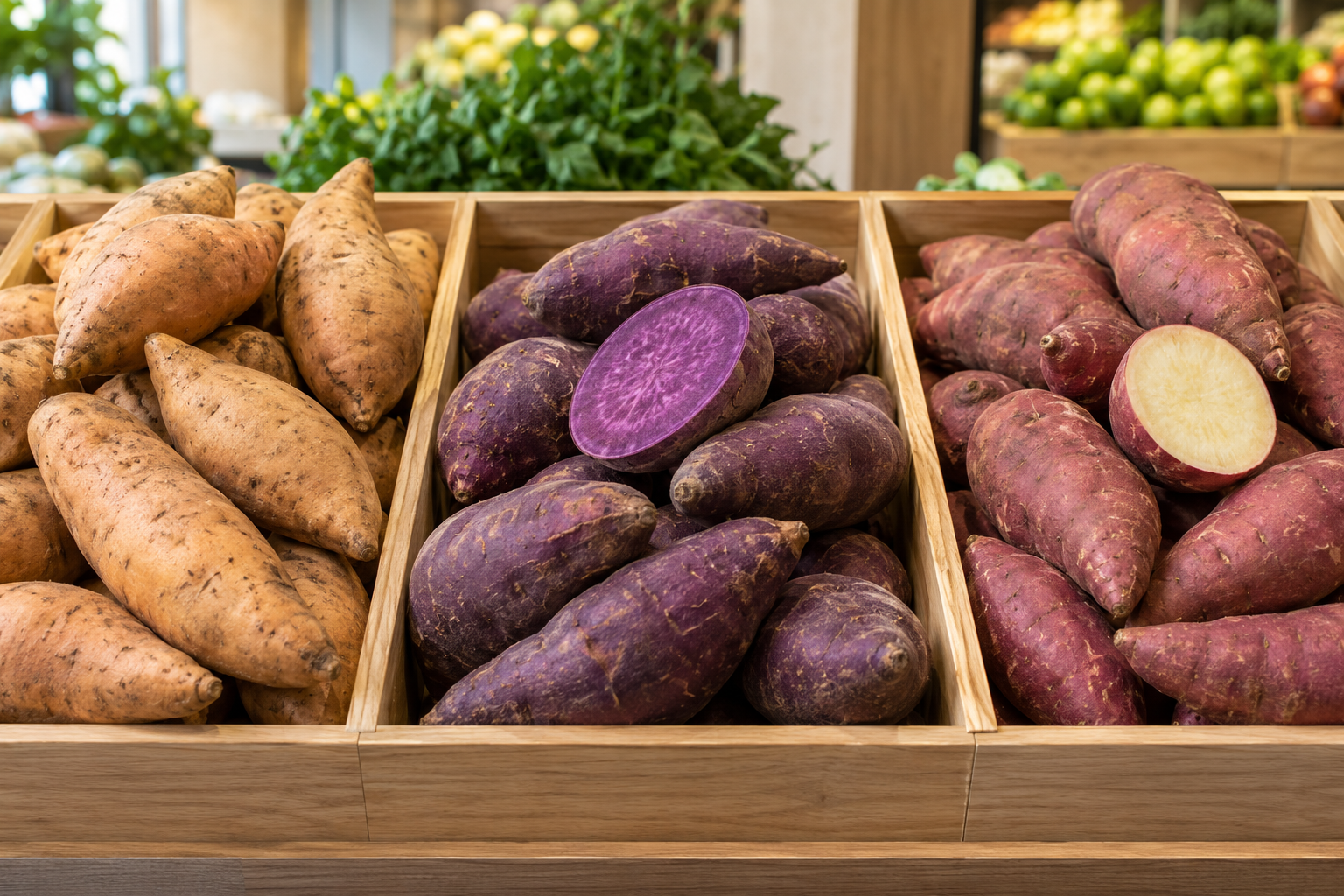 Variety selection should follow the buyer's intended cooking method and sales channel. AI-generated editorial illustration.
Matching Sweet Potato Varieties to Singapore Buyers
The following channel opportunities are suggested applications to test with buyers, rather than measured market shares. Begin with a defined use case and confirm performance through samples before committing to a regular shipment programme.
| Variety | Potential application | Priority for the buyer's trial |
|---|---|---|
| Cilembu | Whole roasted sweet potatoes and specialty produce retail | Sweetness and texture under an agreed baking method; origin documentation |
| Purple sweet potato | Desserts, bakery ingredients, and colourful prepared dishes | Flesh colour, cooked consistency, and usable yield |
| Murasaki | Fresh retail, roasted sides, and foodservice portions | Flesh characteristics, portion uniformity, and eating quality |
Retail and Specialty Produce
Retail programmes benefit from a clear product identity. Buyers should agree whether the offer is a loose display, a fixed-weight pack, or a count-based pack. Photograph an approved sample beside a scale so that the commercial specification describes a repeatable product. Cooking instructions should be checked against the actual variety supplied.
For a new listing, start with a manageable allocation and track sell-through, complaints, and unsold stock. This gives both parties better information than committing immediately to a large quantity based only on an appealing sample.
Foodservice and Ingredient Buyers
Restaurants and central kitchens should assess cost per usable portion. A lower purchase price may offer little advantage if irregular sizes increase preparation time or the cooked texture does not match the recipe. Test peeling loss, cooking yield, colour retention, and consistency after holding.
Fresh roots and prepared ingredients also require separate commercial planning. A customer seeking frozen cubes, puree, or flour needs the appropriate product specification and regulatory classification; a fresh-root shipment is not an interchangeable substitute.
Singapore Import Requirements for Fresh Sweet Potatoes
Importer Licensing and Shipment Permits
For commercial imports of fresh fruits and vegetables, the Singapore importer needs the relevant SFA licence. Businesses must be registered with ACRA and activate their UEN with Singapore Customs. Arrange the shipment declaration and import permit through TradeNet before importation, using the correct product classification. See SFA's commercial food import guidance and Singapore Customs' import procedures.
Residue Compliance and Carton Labels
SFA permits fresh produce imports from any country or region, subject to its requirements. Produce must comply with prohibited-pesticide and residue-limit rules. Every carton or basket must identify the producer's name and address, the product, and its export or packing date. Cutting, peeling, or freezing changes the category to processed food. See SFA's product-specific requirements.
Build label approval into the order process. The buyer should receive the proposed artwork before packing starts, and the packing team should check that the actual cartons match the approved version. Add batch identification and commercial details needed for receiving and traceability without replacing the mandatory particulars.
Phytosanitary Documentation: Check the Actual Use
NParks lists fruits and vegetables for consumption among products that do not require a phytosanitary certificate under its stated requirements. Planting material is treated differently. Do not assume that planting-material rules apply to edible roots. Confirm the shipment's intended use and any origin-country export obligations, buyer documentation, or onward-destination requirements separately. Source: NParks.
Quality Specifications That Protect the Buyer's Margin
A useful purchase specification describes measurable acceptance criteria. Terms such as "premium" or "Grade A" should be supported by written details rather than treated as a complete standard. Buyers can use the site's sweet potato grading guide as a discussion starting point and agree the final specification for their own order.
- Identity: variety, declared origin, and agreed skin and flesh characteristics.
- Sizing: weight range per root and the permitted proportion outside that range.
- Condition: agreed limits for cuts, skin damage, sprouting, and other defects; reject decay.
- Presentation: cleaning method, carton net weight, ventilation, and pallet arrangement.
- Verification: sampling method, inspection timing, photographic evidence, and claims process.
Assess roots from several cartons and positions in the load. Keep an approved reference specification and record results consistently so that a supplier's performance can be compared across repeat deliveries.
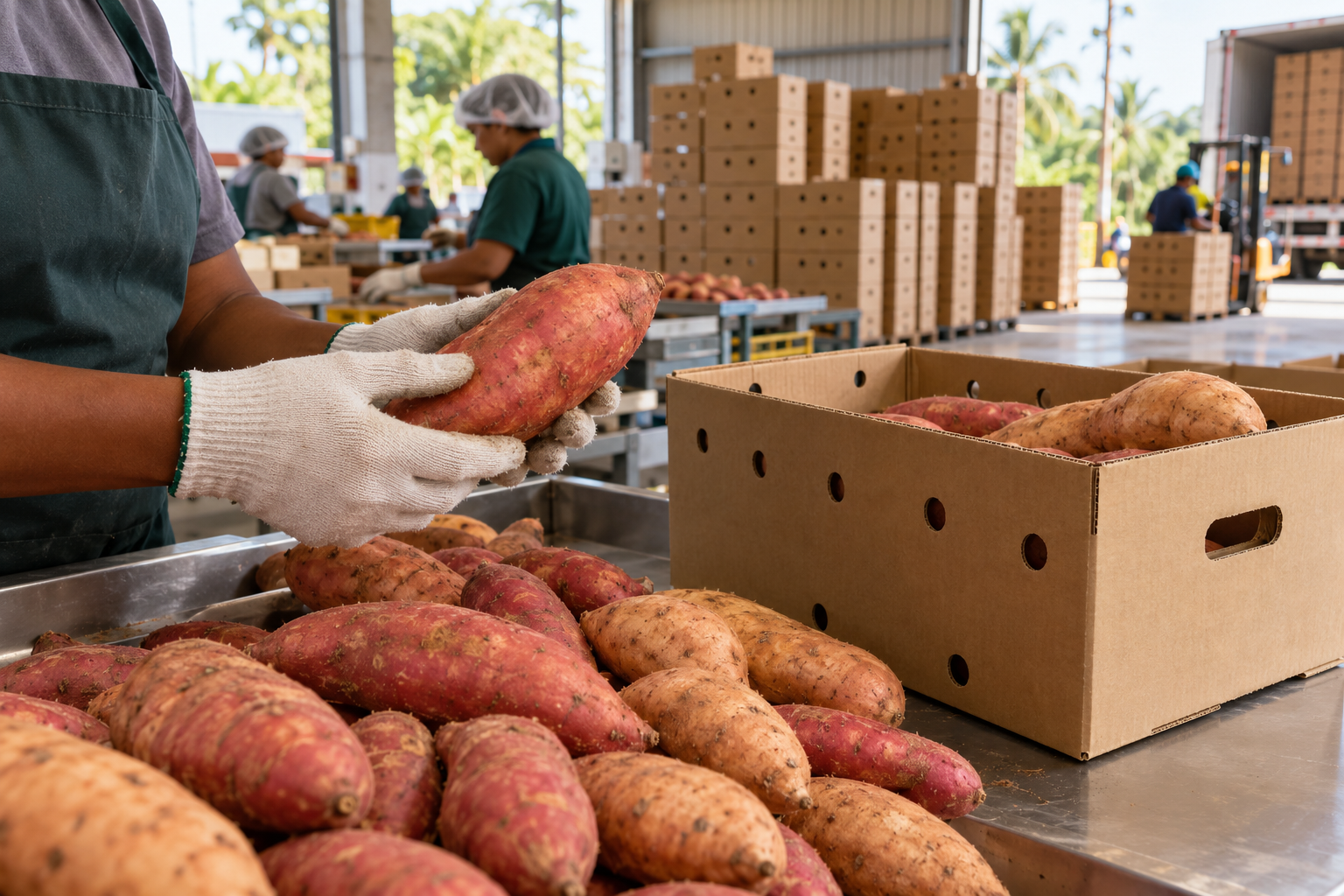 Agree quality, packaging, and acceptance criteria before dispatch. AI-generated editorial illustration; not a photograph of CBN facilities.
Shipping, Storage, and Arrival Planning
Sweet potatoes are sensitive to chilling. UC Davis recommends commercial storage at 12.5–15°C, with conditions adjusted to the handling stage. Its guidance also stresses gentle handling and curing to reduce damage-related deterioration. Treat this as a technical starting point: validate the shipment settings, humidity, ventilation, and intended storage duration for the cultivar and packaging. Source: UC Davis Postharvest Research and Extension Center.
Plan the Complete Delivery Cycle
Ask the logistics provider for a door-to-door schedule covering collection, export clearance, port cut-offs, the sailing, Singapore clearance, and final delivery. A quoted sailing time alone does not represent the product's total time in transit. Allow for receiving appointments and inspection so cartons do not sit unnecessarily after arrival.
For smaller orders, compare consolidation with dedicated capacity. A shared shipment should only be used where the cargo, handling, and temperature requirements are compatible. For larger programmes, assess whether the receiving warehouse and customer network can move the quantity efficiently.
Packaging and Receiving Controls
Specify ventilated cartons with sufficient strength for the agreed stacking plan. Check that ventilation openings remain usable after pallet wrapping and loading. At destination, record arrival condition, carton integrity, sampled root quality, and available temperature records before distributing the stock. Further packaging considerations are covered in the CBN export packaging guide.
Pricing and Landed-Cost Planning
Request a current quotation for a defined variety, grade, quantity, packing format, shipment window, and named delivery term. Specify currency and quotation validity. The historical trade averages in this report should not be used as current FOB, CIF, wholesale, or retail offers.
Sweet potatoes fall outside Singapore's dutiable goods categories and are ordinarily subject to import GST rather than customs duty. The prevailing GST rate is 9%; the applicable import tax base depends on the transaction and valuation rules. See Singapore Customs, its GST valuation guidance, and IRAS import GST guidance.
| Cost component | What to confirm |
|---|---|
| Product and packing | Variety, grade, net weight, carton specification, and included services |
| Freight and insurance | Origin, destination, shipment mode, and responsibility under the agreed term |
| Destination handling | Clearance, terminal charges, local delivery, storage, and inspections |
| GST cash flow | Tax base, payment arrangements, and any applicable recovery or scheme |
| Commercial losses | Measured shrinkage, rejected roots, markdowns, and claims recovery |
Working formula: cost per saleable kilogram = total relevant landed cost ÷ saleable kilograms. Keep recoverable GST separate when assessing trading margin, while including its timing in the cash-flow plan.
Market Outlook and a Practical Entry Strategy
The strongest commercial approach is to build repeat business around a specific customer need. For Indonesian suppliers, that may mean a reliable roasting product, consistent purple flesh for a kitchen, or a uniform retail pack. Each proposition should be tested rather than supported by an unverified promise of market growth.
From Trial Order to Repeat Programme
- Define the channel. Identify the customer, cooking method, pack format, and expected order frequency.
- Approve representative samples. Compare eating quality and usable yield under a repeatable test.
- Agree specifications and responsibilities. Document quality, labels, delivery terms, payment, and claims.
- Run a controlled first shipment. Measure arrival quality, handling losses, sales, and feedback.
- Scale against evidence. Increase volume when repeated deliveries and customer orders justify it.
Monitor supplier performance and customer sell-through alongside changes in freight, exchange rates, and crop availability. Keep an alternative supply plan for disruptions, while maintaining a consistent specification for customers. A repeat programme should make quality easier to predict and procurement easier to manage.
Singapore offers Indonesian exporters a proven trading relationship to develop. The opportunity is best approached through disciplined product selection, accurate documentation, and delivery performance that buyers can verify. PT Cakra Baja Niaga offers Cilembu, Purple, and Murasaki sweet potatoes for international buyers. Share your Singapore delivery requirements, preferred variety, packaging, and target quantity to begin a sourcing discussion.
Looking to source premium Indonesian sweet potatoes?
PT Cakra Baja Niaga supplies export-grade Cilembu, Purple, and Murasaki varieties to buyers worldwide.
Continue reading
Wholesale Sweet Potatoes Indonesia: B2B Export Guide 2026
Source premium wholesale sweet potatoes Indonesia for import. Quality standards, export logistics, varieties, pricing & supplier partnerships.
Read article
Sweet Potatoes Supplier Indonesia: Quality & Export Guide
Find reliable sweet potatoes supplier Indonesia offering premium export quality. Learn about sourcing, grading, logistics, and partnerships.
Read article
Sweet Potatoes Grading Guide for International Buyers
Comprehensive sweet potatoes grading guide for exporters and importers. Learn USDA standards, size classification, defect tolerance, and quality control.
Read article